

- Check in and out: to check in and out of a visit you are assigned to, and to tick tasks. By default that is Organisation Owners, Service Provider Admins, Care Managers, Team Leads and Carers.
- Check in and out together with Edit schedule: to record on behalf of the assigned team member. By default that is Organisation Owners, Service Provider Admins and Care Managers.
- Visit notes: to add notes. Expenses: to add expenses. By default both are Organisation Owners, Service Provider Admins, Care Managers, Care Coordinators, Team Leads and Carers.
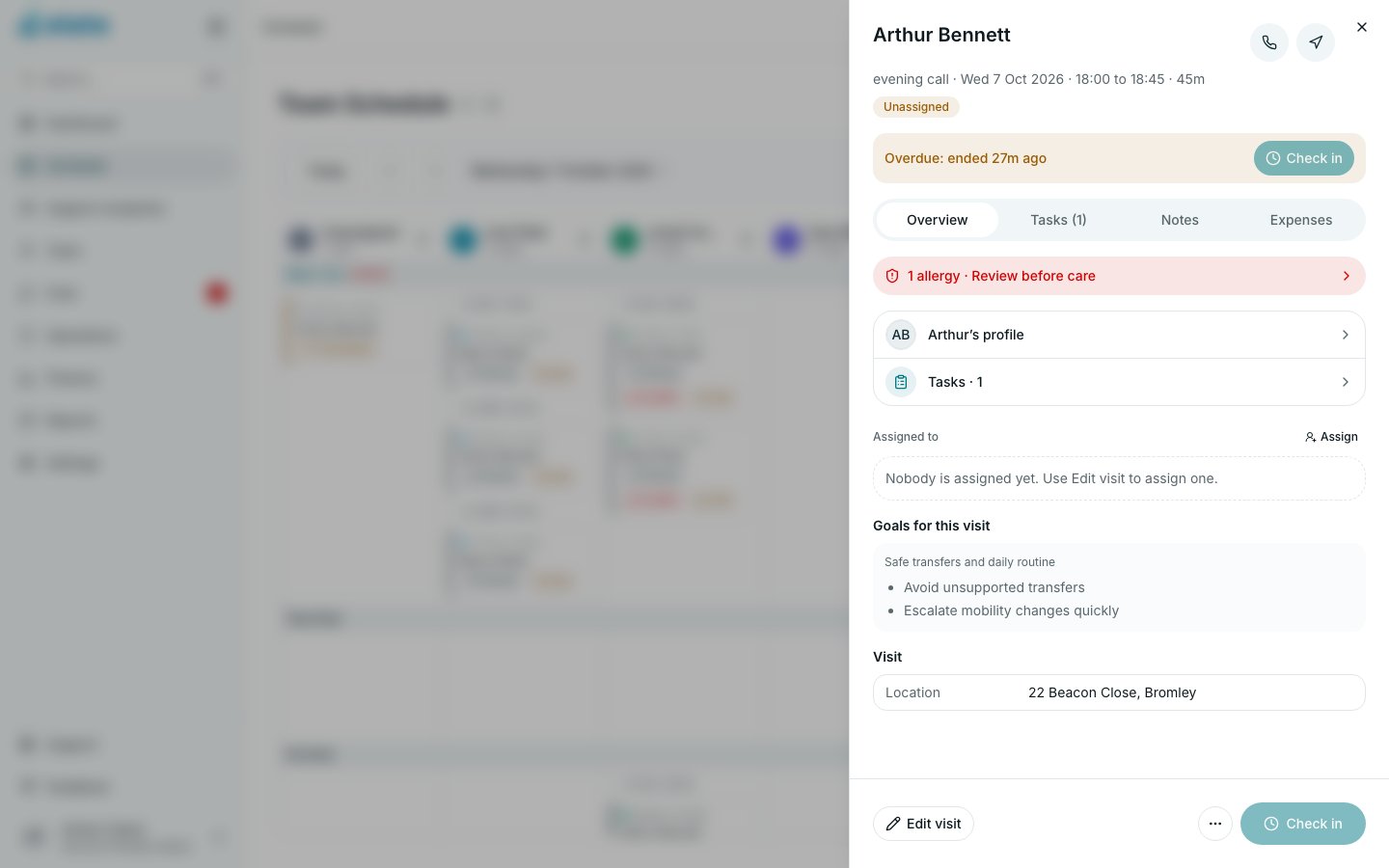
What the sheet shows
The top of the sheet names the support recipient, with the visit’s title, date, time and length, its status, the team member and how it repeats. A Conflict badge appears if the team member has an overlapping visit. Buttons let you call the person and get directions when a phone number and address are on record. On the day of the visit, and once anything has been recorded, a status line below the header says where the visit is, for example “Shift starts in 2h 05m”, with Check in beside it when you can use it. The sheet has four tabs: Overview, Tasks, Notes and Expenses. Overview shows any handover to read first (Handover, before you start), the person’s allergies, links to their profile and the tasks, who is Assigned to the visit, and facts such as Location, Repeats and Handover.Check in
1
Select Check in
Open the visit and select Check in, either in the status line or at the bottom of the sheet.
2
Confirm if asked
If something is unusual, Elate asks Check in anyway? and tells you why, for example “This visit is not scheduled for today.”, “You are not the assigned carer. This records a check-in on their behalf.” or “This visit was marked missed. Checking in records a late arrival.” Select Check in anyway to carry on, or Back.
Check out
1
Select Review and check out
When the visit is in progress, select Review and check out.
2
Read the summary
Ready to check out? shows how many tasks are completed and how many notes are recorded. It also tells you if tasks have no outcome recorded, and suggests adding a care note if there is none.
3
Confirm
Select Check out. The summary never stops you checking out. The visit becomes Completed.
Tasks
The Tasks tab lists the visit’s checklist, grouped by category. Tick a task to mark it done. If the carer already recorded a different outcome for it, Elate asks Mark this task as Done instead? before replacing it. Once a visit is completed or cancelled, the checklist is read-only, except for people whose role includes Edit schedule. To change what is on the visit (needs Edit schedule):1
Open the checklist editor
Select Edit checklist, or Add tasks if the visit has none.
2
Pick tasks and packages
Choose the packages and tasks the carer should tick off. Tasks the carer has already recorded stay on the visit whatever you pick.
3
Save
Select Save checklist. On a repeating visit, choose This visit, This and following visits or All visits, then Save.
Notes
1
Select Add note
On the Notes tab, select Add note.
2
Choose the kind
Choose Care note, Handover or Internal. The Elate Care app offers Care note and Handover only.
3
Write and save
Write the note. If your role can upload documents, you can add an Attachment (optional). Select Add note.
- Handovers carry forward. A handover note appears on this person’s future visits until someone turns it off. The Notes tab shows a red dot when there is one. Anyone who can write notes can select Turn off on a handover; this cannot be undone.
- Editing and deleting. The author can Edit or Delete their own note for 12 hours. People whose role includes Edit schedule can do so at any time. A deleted note is kept on the audit trail.
- Draft handover with Eli. When your organisation uses AI features, this button drafts a handover from the person’s visit notes from the last three days. The draft opens in the note form for you to check and change before you save it. See AI settings and your data.
Expenses
On the Expenses tab, add parking, shopping or other costs, or mileage. An expense can be edited or deleted until it is approved. See Expenses and mileage.More actions
For people whose role includes Edit schedule, the bottom of the sheet holds Edit visit (see Creating and editing visits) and, on a cancelled visit, Restore. The More visit actions menu (the three dots) offers:- Report an incident or Report a safeguarding concern, if your role allows it. See Incidents and safeguarding.
- Copy link to this visit.
- Cancel visit… and Delete visit…, for people whose role includes Edit schedule. See Cancelling, restoring and deleting visits.